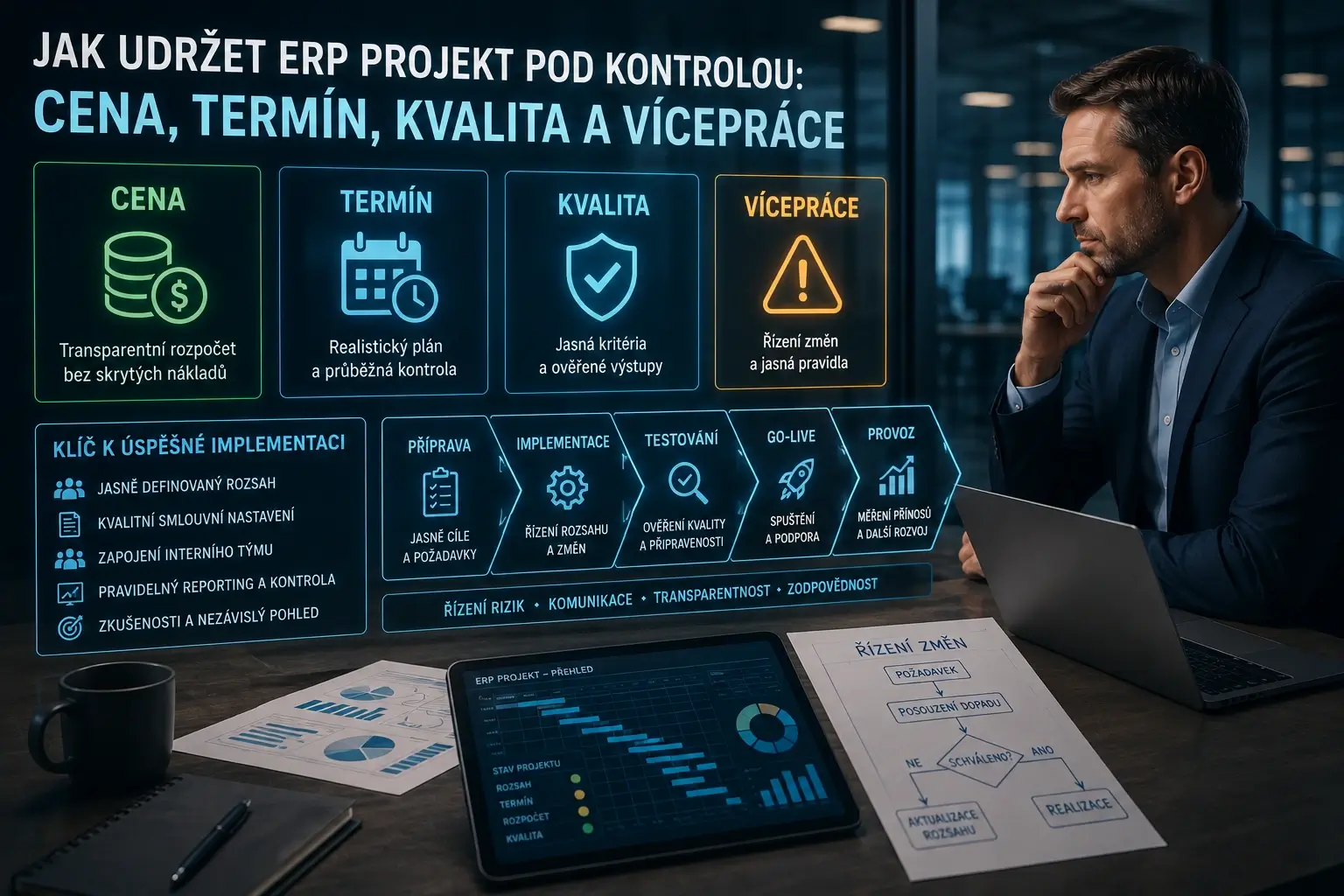
Choosing a system is just the beginning. The real test comes during implementation
Carefully selecting an ERP system is an important step. However, it does not in itself guarantee a successful project. The real test comes when the new system begins to be implemented. Only then will it become clear whether the project scope was defined precisely enough, whether responsibilities are clearly delineated, whether the vendor correctly understands the scope, and whether the customer’s internal project team has the necessary capacity.
An ERP system implementation doesn’t necessarily go over budget because the company chose the wrong system. It often goes over budget because the scope wasn’t properly managed, the contract terms weren’t set up correctly, risks weren’t identified in a timely manner, or the project was managed too reactively. Cost, timeline, and quality in an ERP project won’t take care of themselves. They must be managed from the very beginning.
The license price is not the total cost of the ERP project
When selecting an ERP system, the most attention is often paid to the price of licenses. However, this is only one part of the total costs. The economics of an ERP project also include implementation work, system customization, integration, data migration, training, testing, post-launch support, maintenance, further system development, and any additional work. Therefore, the lowest price in a quote does not necessarily mean the lowest project costs. It is important to evaluate the total cost of an ERP system over time—not just the initial purchase, but also implementation, operation, support, and future development. This is often where the difference lies between an offer that seems attractive at first glance and a project that makes economic sense in the long run.
Extra work doesn’t just happen by chance
Scope creep in ERP projects is usually the result of an unclear or incomplete scope definition. It occurs when requirements, integrations, responsibilities, data migration, or rules for approving changes are not precisely defined. The risk also increases when key users are brought on board too late, test scenarios are not prepared, or management delays important decisions. Therefore, scope creep is not merely a technical problem. It is primarily a problem of project management, preparation, and contractual terms. If it is not clear from the outset what is included in the scope of work, what is not included, and how changes will be handled, the project will not be properly managed until a dispute arises. And by then, it is usually too late.
An ERP project must have a clear scope
Without a clearly defined scope, it is impossible to manage cost, timeline, or quality. The scope of an ERP project must clearly define which processes will be covered, which integrations will be implemented, what the vendor is to deliver, what the customer must prepare, and how change requests will be approved. It is equally important to specify what is not included in the project. It is precisely these unspoken expectations that are often the source of disagreements, additional work, and schedule delays. The more precisely the scope is defined at the outset, the less room there is for differing interpretations during implementation.
The contract model is a project management tool
A good contract is not just an administrative formality. In the context of ERP system implementation, it is a practical tool that helps manage scope, cost, timeline, and quality. A high-quality ERP contract model should clearly define, in particular, the scope of delivery, the schedule, the responsibilities of the parties, the process for approving deliverables, acceptance criteria, change request management, rules for additional work, post-launch support, and the terms for further system development. If the contractual framework is not specific enough, the customer has limited options for enforcing the price, timeline, and quality during the project. An ERP project must make sense not only functionally but also economically. Therefore, it is necessary to address the contractual terms before the project reaches a stage where the options for change are already limited.
Even the best ERP system can’t replace an in-house team
The implementation of an ERP system does not depend solely on the vendor. The customer’s internal team plays a crucial role. Key users must be familiar with the processes, understand the needs of their departments, communicate with the vendor, and verify that the proposed solution aligns with the company’s reality. At the same time, they must have the actual capacity to dedicate to the project. If an ERP project is run solely “on the side” of regular work, the risk of delays, superficial testing, unclear decisions, and poor-quality results increases significantly. An ERP project is not purely an IT activity. It affects finance, sales, production, logistics, purchasing, warehousing, controlling, and reporting. Management must therefore provide the project with direction, priority, and authority.
Why It Makes Sense to Hire an Independent ERP Consultant During Implementation
An independent ERP consultant helps the client keep the project under control. They are not part of the vendor’s team, do not sell a specific system, and their role is to protect the client’s interests. Above all, they bring their experience to the implementation. They know where ERP projects most often fail, and where additional work, delays, differing expectations, or disputes between the client and the vendor arise.
Throughout an ERP project, an independent consultant helps monitor the scope, cost, timeline, quality of deliverables, change requests, risks, and acceptance criteria. At the same time, they facilitate communication between the client and the vendor and assist in preparing decisions for management. The goal of an independent consultant is not to replace the vendor or the internal team. Their value lies in bringing experience, perspective, and a control mechanism to the project, which helps prevent costly mistakes.
Go-live is not the end of an ERP project
System go-live is an important milestone. However, it is not the end of the ERP project. The true value of ERP becomes apparent only in day-to-day operations. After go-live, it is essential to monitor whether the system supports key processes, whether users are working correctly, whether reporting meets management’s needs, and whether new manual workarounds outside the system are emerging. A successful ERP implementation isn’t just about getting the system up and running. It’s about the system beginning to support the way the company wants to operate, manage its processes, and make decisions going forward.
Summary: Price, Timeline, and Quality Must Be Managed
An ERP project cannot be managed solely on the expectation that “the vendor will deliver.” Cost, timeline, scope, and quality must be actively managed from the start. It is essential to have a clear project brief, a properly defined scope, well-defined contractual terms, a prepared internal team, managed change requests, and regular project status reporting. For an ERP system implementation to deliver the expected results, simply choosing the right system is not enough. It is necessary to properly manage the entire project—from contract terms through implementation to verifying the benefits during routine operations.
Do you want to keep your ERP project under control?
We’ll help you set up the selection process, contracts, scope, and project management so that cost, timeline, and quality remain under control. We’ll minimize scope creep, define a realistic scope, and keep your ERP project within both financial and process boundaries. Our goal is not to replace the vendor or the internal team. The goal is to help the client manage the project in a way that makes sense from a process, financial, and long-term perspective.