ERP system integration is more than just a technical connection
A modern ERP system is one of the cornerstones of a company’s digital transformation. However, it is usually not enough on its own. In manufacturing, sales, and distribution companies today, ERP commonly integrates with other systems—such as PLM/PDM, MES, WMS, BI, CRM, or specialized applications for quality, service, and maintenance. It is precisely in these integrations that the main problem often arises. It’s not just a matter of whether the systems can technically communicate with each other. It is more important to understand the role each system plays within the overall application architecture. In other words: where the ERP system ends and another system begins. If this is not clearly defined, it leads to duplication, manual data entry, inconsistent reporting, complex interfaces, and unnecessary costs for operations and future changes.
ERP no longer operates in isolation
In the past, ERP systems were often viewed primarily as tools for finance, purchasing, inventory, sales, and manufacturing. Today, their role is broader, but they are also part of a larger ecosystem.
In addition to ERP, a company may use, for example:
- PLM/PDM for product data management, design documentation, and change management,
- MES for managing production on the shop floor and monitoring the actual production process,
- WMS for detailed management of warehouse processes,
- BI for reporting, controlling, and management analytics,
- CRM for business processes and customer interactions.
The problem isn’t the number of systems itself. The problem arises when it’s unclear which system is responsible for what.
A company should clearly define the following:
- where the core data truth is created,
- which system controls a specific process,
- where changes are approved,
- where the reporting comes from,
- Who is responsible for data quality,
- how data is transferred between systems.
Without this clarification, users may easily end up entering the same data in multiple places, different departments may work with different results, and management may be unsure which figures to trust.
The Biggest Risk of ERP Integration: Duplications and Overlaps
ERP, MES, PLM, WMS, and BI naturally overlap in some areas. MES can handle production scheduling. So can ERP. PLM can support change management. So can ERP. BI can consolidate reporting. However, some of these outputs may also be available directly in ERP. The overlap itself is not a problem. The problem arises when a company fails to decide which system will be the primary one for a given area.
Poorly configured ERP system integration then leads to the following:
- the same activity takes place in multiple systems,
- different dates are generated,
- The reports are compiled manually,
- Users do not trust the results,
- Every change is expensive and slow,
- dependence on suppliers is growing,
- Operating and maintenance costs are increasing.
The goal of integration, therefore, is not to connect “everything to everything.” The goal is to design the architecture so that each system has a clear role and data flows where it creates value.
Integration debt builds up gradually
Many companies today aren’t just dealing with the selection of a new ERP system. They’re also grappling with the consequences of years of gradually adding additional applications. First, they implement an ERP system. Then a warehouse management system. Next, an MES. Later, BI, CRM, a planning tool, or another industry-specific application. Each system is integrated in some way based on current needs. This may work in the short term. In the long term, however, integration debt accumulates. This is mainly manifested by the company having numerous interfaces, unclear data ownership, poor documentation, complex change management, and high costs for each additional modification. The problem usually becomes fully apparent only when the company grows, changes its processes, needs to consolidate reporting, or wants to take advantage of more advanced digitization and automation. At that point, it’s no longer just about technical interfaces. It’s about the architecture of the entire ERP environment.
Good integration is characterized by simplicity
A well-designed ERP system integration isn’t the one with the most interfaces. It’s the one that is understandable, sustainable, and supports the company’s actual processes.
Good integration has several characteristics:
- Each system has a clearly defined role,
- Data is not duplicated,
- Users do not have to manually retype the information,
- Reporting is based on reliable data,
- The interfaces are documented,
- The changes are controlled,
- Operating costs are under control,
- The architecture enables the company’s continued growth.
Architecture enables the company’s continued growth. Integration is not successful simply because “the systems communicate with each other in some way.” It is successful when it simplifies work, reduces errors, and helps the company make decisions more quickly.
Why It Makes Sense to Have an Independent ERP Consultant for Integration
ERP system integration is not merely a technical issue. It is a decision about how a company will manage its processes, data, responsibilities, and future development. An ERP vendor naturally tends to focus on incorporating as many features as possible into its system. Conversely, MES, PLM, or WMS vendors typically see opportunities for broader use of their solutions. Internal departments have their own practices and priorities. That is precisely why an independent perspective makes sense.
An independent ERP consultant primarily helps with:
- define the role of ERP and related systems,
- determine where the primary data source should be located,
- identify duplicates and unnecessary overlaps,
- decide what should be in the ERP and what should be in a specialized system,
- prepare integration specifications for the supplier,
- assess the impact of the interface on cost, schedule, and operating costs,
- reduce the risk of additional work,
- Design an architecture that will be sustainable in the long term.
The goal is not to replace the client’s knowledge of their internal business. The client always has that knowledge. A consultant’s value lies in their experience with the ERP environment, their understanding of typical risks, and their ability to evaluate the architecture without being tied to a specific vendor.
Are you working on integrating your ERP system with other systems?
We’ll help you determine where ERP ends and where the roles of systems such as PLM, MES, WMS, or BI begin. We provide independent ERP consulting for the selection, implementation, reimplementation, and integration of ERP systems. We help companies eliminate duplication, reduce the risk of extra work, and configure integration so that it makes sense from a process, data, and economic perspective. Our goal is not to push a specific system. The goal is to design an ERP environment that supports the business, not hinders it.
Contact us and let’s discuss how an independent perspective can help your specific ERP environment.
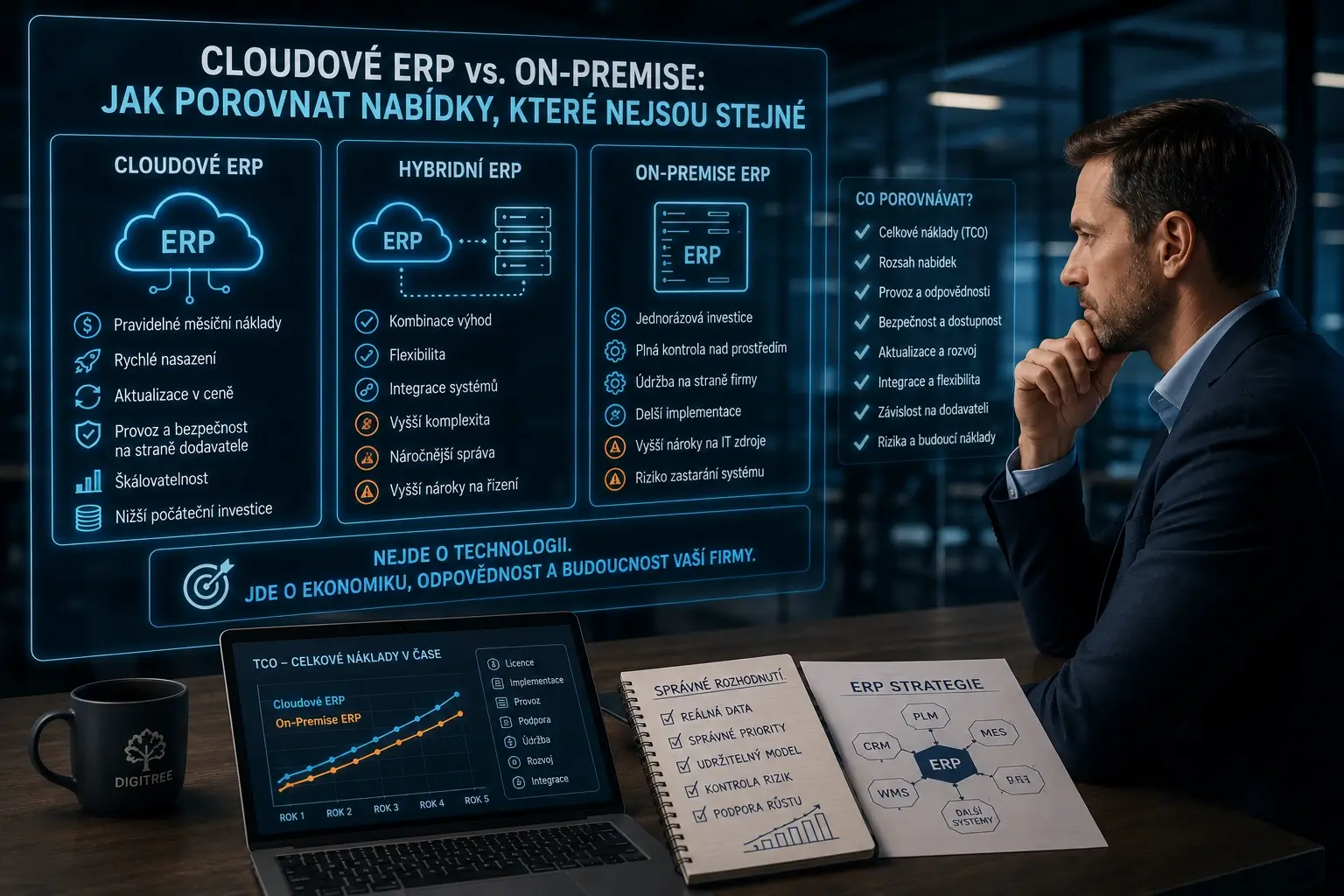
Cloud ERP vs. On-Premise: How to Compare Solutions That Aren’t the Same
When selecting an ERP system, companies often find themselves in a situation where they have various types of proposals on the table. One is a cloud-based ERP, another is an on-premises solution, and sometimes a hybrid model is also presented. At first glance, it may seem that this is primarily a question of technology: will the system be operated in the cloud or on the company’s own infrastructure? In reality, the difference runs much deeper. Cloud-based ERP and on-premises ERP differ not only in terms of where they are operated, but also in terms of financing, responsibilities, maintenance costs, updates, security models, customization options, contract terms, and long-term dependence on the vendor.
That’s why it doesn’t make sense to simply ask, “Is the cloud better, or is on-premises better?” The more appropriate question is, “What overall operational, economic, and contractual model is the company actually purchasing?”
Why Cloud ERP Often Seems More Expensive
At first glance, cloud ERP may seem expensive. The costs are usually visible in recurring payments—for licenses, operations, hosting, updates, support, or service availability. But that doesn’t mean the cloud is always more expensive. With the on-premises model, some of the costs are often hidden elsewhere. A company often has to factor in its own infrastructure, server management, internal IT capacity, backups, security, upgrade projects, or future environment modernization. So the cloud often doesn’t seem expensive simply because it’s automatically more expensive. It seems expensive because it displays costs on an ongoing and transparent basis. With on-premises solutions, some costs may not become apparent until later—for example, during an upgrade, an infrastructure change, a security audit, a system expansion, or when new integrations are needed. Therefore, when selecting an information system, it’s not enough to compare the initial price quoted. It’s important to compare the total costs over time.
“On-premise” no longer necessarily means the same thing it used to
On-premise ERP was the standard operating model for a long time. Companies had full control over the system, ran it on their own infrastructure, and made their own decisions regarding updates, customizations, and the technical environment. Today, the situation is different. For many modern ERP solutions, the cloud is now the primary direction of development. The on-premise option may still be available, but it does not always have the same product priority, the same scope of development, or the same long-term outlook. That doesn’t mean that on-premise ERP doesn’t make sense. It may still be relevant for certain companies, industries, or regulatory requirements. However, it’s important to verify exactly what the vendor means by its on-premise offering.
A company should ask questions such as:
- How long will the on-premises version be supported,
- how the updates will be carried out,
- whether the new features will be available just as they are in the cloud,
- Who will bear the costs of infrastructure and operations,
- how security will be addressed,
- What will the costs be for a future upgrade?
- whether the model will limit the system’s further development.
Therefore, on-premises solutions cannot automatically be viewed as a fully equivalent alternative to the cloud. It is necessary to understand their long-term context.
What to Compare When Choosing an ERP System
If a company receives one proposal for cloud-based ERP and another for on-premises ERP, it should not compare only the license price or the initial investment. It should compare the entire model:
- What is actually included in the price?
- What will the company pay for that isn’t included in the offer?
- What costs will arise in 5 or 10 years?
- Who is responsible for operations, security, and availability?
- How will the updates be carried out?
- How will changes to the system be handled?
- What are the options for integrating with other applications?
- What is the level of dependence on the supplier?
- What is the exit strategy?
- How will the model perform as the company grows?
Only by answering these questions will it be possible to make a fair comparison.
An offer that seems cheaper at first may not be cheaper in the long run. And a more expensive offer may not be a bad deal if it includes services, responsibilities, and risks that the company would otherwise have to bear on its own.
TCO is more important than the purchase price
When evaluating ERP solutions, it makes sense to consider the total cost of ownership (TCO). A company should include in its TCO not only licenses, but also implementation, infrastructure, operations, system administration, support, updates, integrations, customizations, training, security, internal resources, and future development. This is where the real difference between the cloud and on-premises models often becomes apparent. Cloud ERP shifts part of the investment to ongoing operating costs. On-premise ERP may require a higher initial investment, but it also places a greater share of the responsibility on the customer.
Neither model is automatically right or wrong. What’s important is that the company understands what model of liability, costs, and risks it is accepting.
A hybrid ERP isn’t always a compromise
Sometimes, a hybrid ERP model emerges as a third option. Part of the solution is operated in the cloud, while another part remains on-premises or in the customer’s specific environment. A hybrid model can make sense when a company needs to combine modern cloud services with operational, integration, or regulatory constraints. At the same time, however, a hybrid model is not automatically simpler. On the contrary, it can increase the demands on integration, data management, accountability, security, and supplier coordination. Therefore, a company should not ask whether a hybrid model offers “the best of both worlds.” It should ask whether it has a clear rationale for a hybrid architecture and whether it can manage its complexity.
The Role of an Independent ERP Consultant
An independent ERP consultant should not tell a company whether to choose a cloud-based ERP, an on-premises ERP, or a hybrid model. Their role is different. They help the company compare offers on an equal footing—that is, not only based on price, but also on scope, responsibilities, risks, contractual terms, future costs, growth potential, and the impact on the company’s operations.
When selecting an ERP system, an independent consultant helps distinguish between:
- what is actually included in the offer,
- what will be paid later,
- what costs might arise later,
- what obligations the company assumes,
- where dependence on a supplier arises,
- which model will be sustainable in the long term.
The goal is not to promote a specific technology. The goal is to help the company understand what it is actually buying.
Don’t just choose between the cloud and on-premises. Evaluate the entire model.
The choice between cloud-based and on-premises ERP isn’t just a matter of technology. It’s a decision about economics, accountability, risk, and the company’s future flexibility.
When selecting an ERP system, it is therefore not enough to simply compare the two prices in the quote.
We need to compare the entire model:
- how costs will change over time,
- who is responsible for what,
- once the system is updated,
- how it will be protected,
- how it will develop,
- how it will be integrated,
- how easy it will be to change or leave it.
Only then can a cloud, on-premises, or hybrid offering be evaluated fairly.
So the most important question isn’t, “Which option is cheaper?” but rather, “Which model makes the most economic, operational, and strategic sense for the company in the long run?”
Are you considering a cloud-based, on-premises, or hybrid ERP solution?
We’ll help you compare ERP proposals so that you can clearly see what they actually include, what costs may arise over time, and what risks are hidden in the operational or contractual model. We’ll also help you evaluate the TCO, assess the scope of the proposals, and set up your ERP project so that it makes sense from a process, economic, and long-term perspective.
Our goal is not to choose between cloud and on-premise based on current trends. Our goal is to help a company select an ERP model that aligns with its processes, capabilities, risks, and future growth.