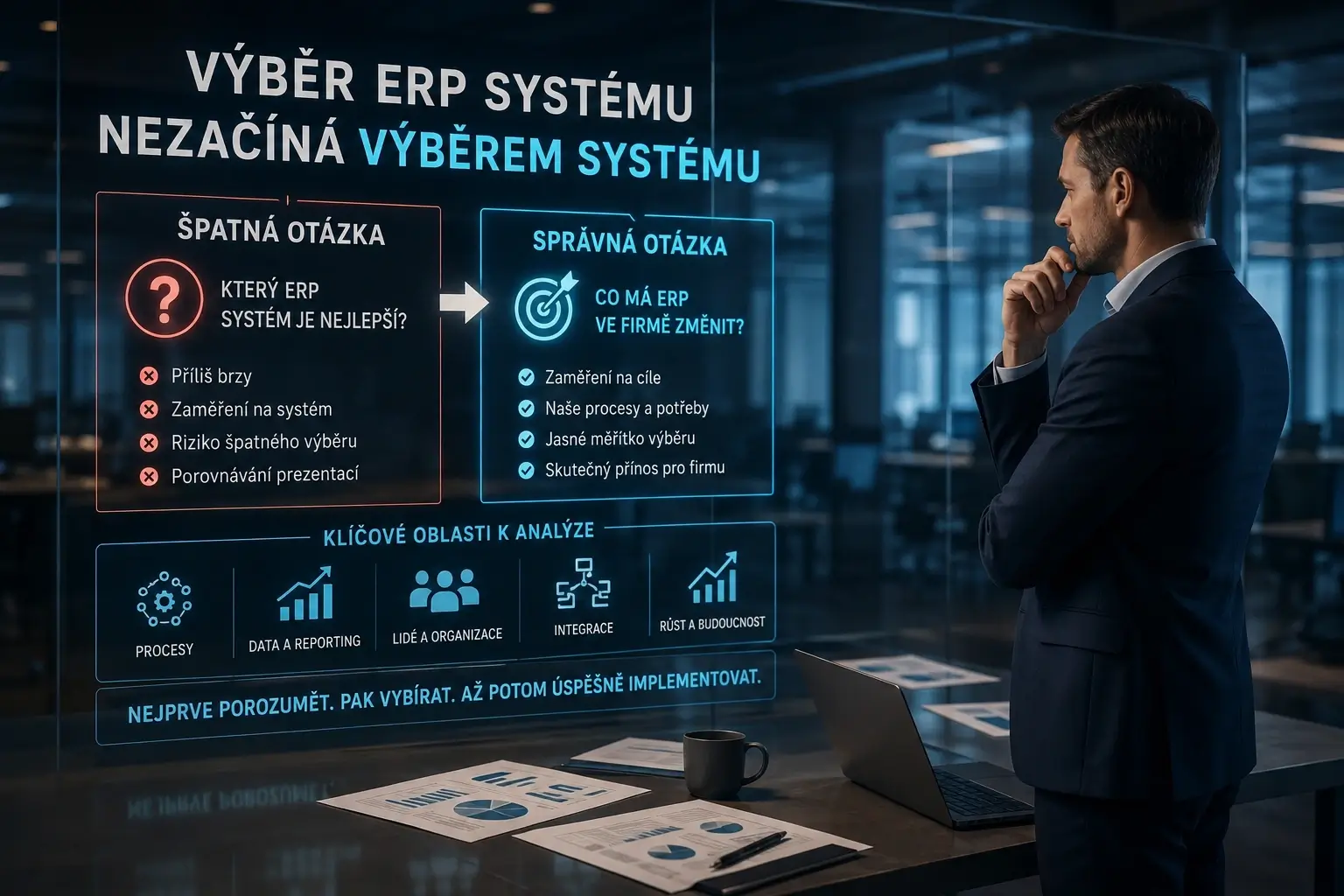
Choosing an ERP system doesn’t start with the question, “Which system?”
When selecting an ERP system, companies often ask, “Which ERP system is the best?” But this very question can set the entire project on the wrong track. There is no single “best” ERP system. There is only the solution that best fits a specific company—its processes, size, industry, data, management style, and future plans.
So the right question isn’t: “Which ERP system should we choose?” But rather: “What should the new ERP system change in the company?” Should it speed up planning? Reduce manual work? Improve inventory management? Enhance reporting? Integrate sales, production, logistics, and finance? Prepare the company for further growth? Only when the company knows the answers to these questions does it make sense to start comparing vendors, features, and prices.
The most common mistake: asking about a specific ERP system too soon
The selection of an ERP system often doesn’t get off to a bad start because the company approaches the wrong vendors. It gets off to a bad start because the company doesn’t ask the right question at the beginning.
Typical questions include:
- Which ERP system is the best?
- Which ERP system is the cheapest?
- What do similar companies use?
- Which supplier has the most references?
- Which system has the most features?
Those aren’t bad questions. They’re just coming too soon.
Before a company begins considering a specific product, it should clarify what problem it wants to solve with the new ERP system. Otherwise, there is a risk that it will compare offers without a clear set of criteria. And without clear criteria, the process of selecting an information system can easily turn into a comparison of sales pitches.
The right question is: What should an ERP system change in a company?
An ERP project should not simply be a matter of replacing an old system with a new one. If the goal is merely to “replace the existing software,” the company will often carry its old problems over into the new environment. The system may go live, but the expected change will not materialize. The purpose of selecting an ERP system is not to find the software with the longest list of features. The purpose is to find a solution that will help the company operate more effectively.
That is why there should be a different set of questions at the beginning:
- Where do we waste the most time these days?
- Which processes are not sufficiently under control?
- Where does manual work or duplicate data entry occur?
- What data on management is missing for decision-making?
- Which activities do we want to speed up, refine, or automate?
- What will the system need to handle as the company continues to grow?
- How can we tell if the new ERP system has actually delivered the expected results?
It is the answers to these questions that determine which ERP system will be right for the company.
Features alone aren’t enough. What matters is the impact on processes.
At first glance, different ERP systems may look similar. In their presentations, most of them cover finance, inventory, purchasing, sales, manufacturing, reporting, or workflow. However, the real difference often becomes apparent only when you look at the details. It’s one thing for a system to “support” a certain functionality. It’s another thing entirely how well it does so—whether it aligns with the company’s processes, whether it’s available out of the box, whether it requires configuration, or whether it will involve custom development. In a presentation, three vendors might respond to the same requirement in a similar way. During implementation, however, their solutions may differ significantly in terms of cost, timeline, risk, and long-term sustainability.
That’s why, when choosing an ERP system, it’s not enough to ask, “Can the system do that?”
We also need to ask:
- How exactly does the system handle this?
- Is this a standard feature?
- Will customization be necessary?
- What will be the impact on implementation?
- How will this solution be maintained in future versions of the system?
- Does the supplier have real-world experience with this?
- Where might additional work arise?
These are the questions that often determine the true quality of a choice.
A high-quality assignment stems from well-formulated questions
The ERP request for proposal is not an administrative formality. It is a tool that translates the company’s needs into a format that allows vendors to prepare comparable proposals. If the request is not precise, each vendor will interpret it differently. Bids will then differ not only in price but also in scope, assumptions, and the extent of services and responsibilities included. This often becomes apparent only later—during implementation. Change requests, additional work, deadline extensions, or disputes over what was and was not included in the bid may arise.
Well-prepared ERP request for proposal (RFP) documentation helps clearly define:
- what the company really needs,
- which requirements are critical,
- what is merely appropriate or supplementary,
- What processes should the ERP system support,
- what results management expects,
- what integrations will be necessary,
- based on what the bids will be evaluated,
- how changes to the scope of the project will be managed.
A high-quality project brief doesn’t mean describing absolutely everything down to the last detail. It means clearly defining what’s essential—the project’s objectives, processes, priorities, risks, and scope.
Without clear specifications, it is impossible to compare bids objectively
One of the biggest risks in an ERP selection process is when a company receives several proposals but is unable to compare them objectively. At first glance, they may appear similar. Each includes licenses, implementation, training, support, and a timeline. Upon closer inspection, however, it becomes clear that each proposal is based on different assumptions. One vendor has included a certain area in the standard package. Another counts it as a configuration. A third has not included it at all and assumes it will be finalized during the analysis phase. As a result, the company is not comparing the actual value of the solutions, but rather different interpretations of its own requirements. This is precisely why a properly prepared request for proposal (RFP) for an ERP system is so important. It safeguards not only the price, but also the scope, timeline, and management’s expectations.
An ERP system isn’t just software. It’s a way of managing a business.
In manufacturing, sales, and distribution companies, it often serves as the backbone of the entire digital architecture. It connects finance, purchasing, sales, warehousing, production, logistics, controlling, reporting, and other systems. Some of these functions may be directly integrated into the ERP system. Others may be handled by specialized tools, such as WMS, MES, PLM, BI, or customer portals. What matters most, however, is that the entire system functions effectively in terms of both processes and data. That is why the selection of an ERP system cannot be viewed in isolation. It is not just a matter of what software the company purchases. It is about how it will manage orders, data, costs, production, inventory, reporting, and decision-making in the years to come. A well-chosen ERP system helps a company work with consistent data, reduce manual work, speed up reporting, and lay the foundation for further digitization. It should not merely be a record of what has happened in the company. It should be a tool that helps manage what will happen next.
How an Independent ERP Consultant Can Help
An independent ERP consultant is not a system vendor; they do not promote a specific technology and have no interest in artificially expanding the scope of the implementation. Their role often begins by helping the company ask the right questions. They help distinguish actual needs from habits, critical requirements from wishes, and vendors’ marketing claims from the real-world impacts on the project. A company knows its own business best. It knows where its current system is holding it back, what users need, and what day-to-day operations look like. An independent ERP consultant brings a second perspective—market knowledge, experience with ERP projects, the ability to compare proposals, and the ability to point out risks that frequently arise during both selection and implementation.
It is particularly helpful for:
- formulating requirements,
- preparing the ERP request for proposals,
- by setting the selection criteria,
- by comparing suppliers’ bids,
- by distinguishing between standard, custom, and bespoke solutions,
- by assessing the economic viability of the solution,
- by identifying risks in the implementation and contractual terms.
The goal is not to make decisions for the client. The goal is to provide the client with enough objective information so that they make decisions based not on their impression of the presentation, but on the actual value to the company.
Don’t just choose a system. Choose the future way your company will operate.
Start with this question: What is the new ERP system supposed to change in the company?
The successful selection of an ERP system does not begin with vendor presentations. It begins with a clear vision of what the company wants to achieve.
Are you considering choosing an ERP system?
We’ll help you prepare your project so that it has clear objectives, a well-defined scope of work, and comparable bids from contractors.
Our goal is not to push a specific system. The goal is to help choose a solution that aligns with how the company actually operates—and how it wants to operate in the future.